Lip combo · Liner + matte
The 90s Lip
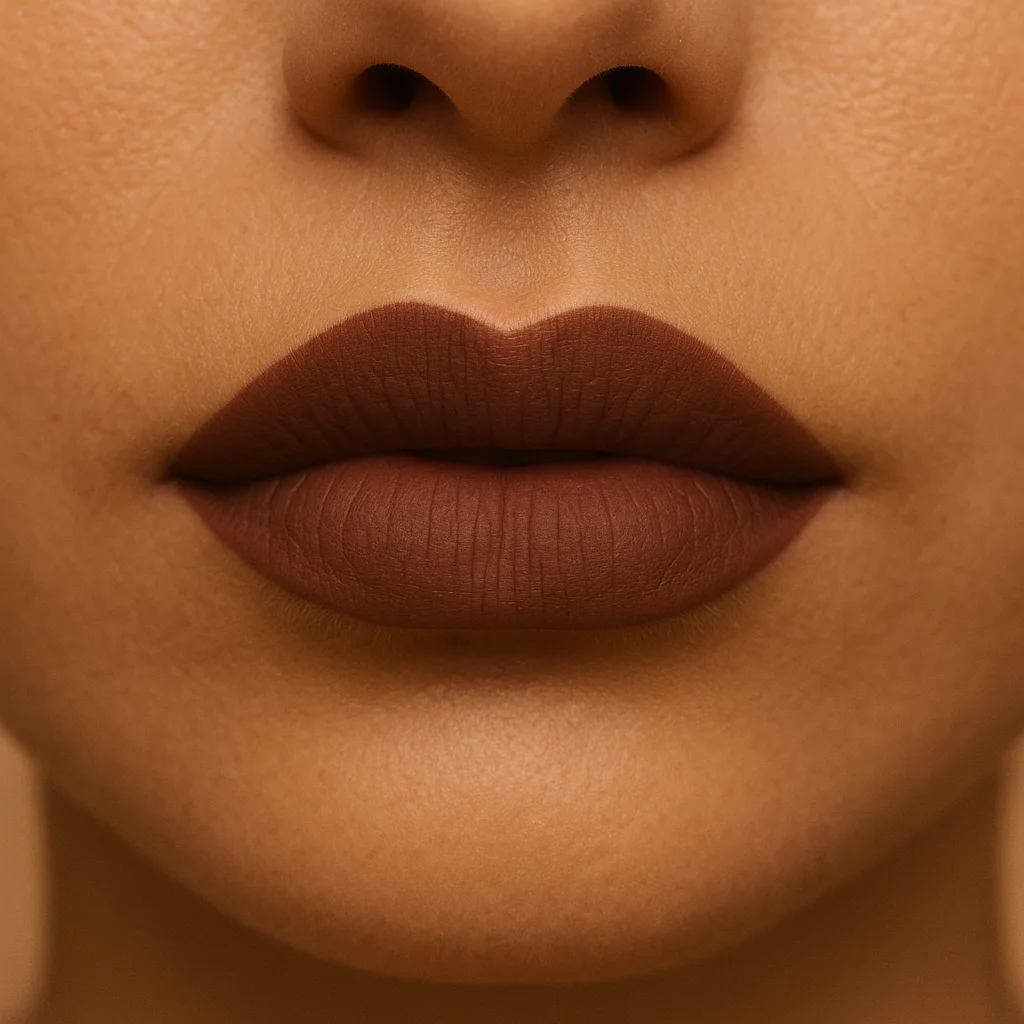
The nineties mouth is a brown liner and a matte brown lipstick, and the technique that makes it work is restraint. The liner is a shade or two deeper than the lipstick rather than a different colour, the lipstick goes on in thin layers instead of one thick coat, and the whole thing is blotted down so it sits like a stain rather than a film. Built that way it wears comfortably and fades evenly; applied in one pass it cracks along the middle of the lip within the hour. The look has been worn continuously since the early nineties, and it reads as sharp rather than costume when the brown is chosen for your own skin instead of copied from a photograph. Budget about eight minutes, and two of those are blotting.
Your skin tone
Skin tones sit on a spectrum, not in three boxes — if you are between two, read both, because undertone matters as much as depth.
Shade matching & colour correcting
Find your undertone
Brown is not one colour, and the undertone inside it decides whether the look reads as a brown lip or as an orange one. Hold the liner and the lipstick together against your bare face in daylight: a cool brown has grey or pink in it and looks almost taupe on the skin, a warm brown has red or gold in it and looks like cocoa. If the pair makes your skin look ruddy or sallow, it is on the wrong side. The lipstick also needs to be the same temperature as the liner — a cool liner under a warm lipstick leaves a visible two-tone edge that no amount of blotting fixes.
Match your liner to your lipstick
The depth ratio is the whole trick: liner a shade or two deeper than the lipstick, lipstick a shade or two lighter than the liner. More than two steps apart and the edge reads as an outline; less than one and the liner stops doing anything. Lighter skin sits best with taupe, soft cocoa and rosewood; medium skin with warm chocolate, cinnamon and caramel-brown; deeper skin with espresso, plum-brown and black-brown. Whatever the depth, keep both products in the same family — a plum-brown liner under a yellow-brown lipstick will separate into two colours the moment you blot.
Liner and gloss by tone
- Light
Cool and neutral browns only, and keep the depth light: a milk-tea or soft mocha matte with a taupe liner. Warm brick, copper and terracotta browns are the ones that turn orange on lighter skin, especially once the gloss-free matte finish takes away any reflection.
- Medium
Warm chocolate and cinnamon are the natural register, with a liner one to two steps deeper. If your skin is olive, add a little red to the brown — a straight yellow-brown can pull green out of olive skin and make the mouth look separate from the face.
- Deep
Espresso, plum-brown and black-brown, and go one step deeper than feels necessary: pale and mid browns read as grey or dusty on deeper skin because they are lighter than the lip underneath. A plum-brown is the safest choice if you are unsure, since the red in it keeps the brown from going ashy.
Why lip colour goes grey — and what to use instead
A brown lip goes grey for the same reason a nude does: the pigment is lighter or cooler than the lip beneath it. Pale and mid browns are often built on white pigment with a little iron oxide, so on deeper lips they sit on the surface and read as dust — and a matte finish makes it worse, because there is no shine to hide the ash. What to use instead: a brown with visible red or gold in it, at least one step deeper than the natural lip, and a lipstick in the same family as the liner. On lighter skin the opposite failure is commoner: a brown so warm it turns orange. If the mouth looks orange rather than brown in daylight, the lipstick is too warm, and blotting it further will only make that clearer.
The kit
What you need
Liner
- Brown lip liner a shade or two deeper than the lipstick — cool taupe-brown for lighter skin, warm chocolate or cinnamon for medium, espresso or black-brown for deeper skin
- A pencil you can sharpen to a fine point; this line is meant to be seen, not blended away
Colour
- Matte brown lipstick in the same family as the liner, a shade or two lighter than it
- A small flat brush, or a clean fingertip, for pressing on thin layers
Tools
- Several tissues for blotting — this is most of the technique
- Translucent powder and a tissue if you want a soft-matte rather than a flat finish
- Cotton buds and micellar water for the outside edge
Before you start: New to a product? Patch-test it on your inner forearm 24 hours before you wear it on your face, and check expiry dates on anything that has been open a while. Stop using anything that stings, itches or breaks you out.
Products & brands
Suggestions, not tested endorsements. These are widely available lines that suit this step; formulas and shade ranges change, so check the version you are buying. No prices and no links — brands are listed by tier so you can choose by budget.
Brown liner, deeper than the lipstick
Drugstore
- e.l.f. Cream Glide Lip Liner
- Collection Plumping Lip Liner
Mid-range
- MAC Lip Pencil — Cork, Stone or Chestnut
- Laura Mercier Caviar Perfecting Lip Liner — 03 Brown Tulle
Premium
- Pat McGrath Legendary Longwear Lip Liner
- Estée Lauder Double Wear Stay in Place Lip Pencil
Matte brown lipstick, same family as the liner
Drugstore
- Collection Soft Matte Lipstick
Mid-range
- NARS Powermatte High Intensity Lipstick
- MAC MACximal Silky Matte Lipstick
Premium
- Estée Lauder Pure Color Matte Lipstick
Tools — tissues, translucent powder, cotton buds
No specific product named here — a damp makeup sponge, a small angled brush or a spoolie from any brand works. No brush, sponge or spoolie could be verified at drugstore or mid-range, so none is named.
No product here is paid for or linked to, and nothing on this page earns a commission. Where a slot has no verified product we say so rather than guess.
Follow along
Step by step
Use Previous and Next, or the arrow keys.
Balm, then blot it almost off
Apply a thin balm, leave it for two minutes, then press your lips onto a tissue until the surface feels dry rather than slippery.
Why it works
Matte lipstick grips a dry surface and slides on a balmy one, so the balm is there to soften the lip, not to stay on it. Two minutes lets it sink in; blotting takes off whatever has not.
Skin tone notes
- Light
Lighter lips are thin-skinned and mark easily, so use a plain balm without menthol or plumping agents and blot gently. If your lips are already flaky, lift the flakes with a damp cloth rather than a scrub, or the matte layer catches on them.
- Medium
Medium lips usually need one round of balm and a firm blot. Check the corners especially — that is where leftover balm collects, and where a matte lipstick starts to break up first.
- Deep
Deeper lips often feel comfortable while still being dry on the surface, so give the balm the full two minutes and blot twice. Matte over a dry patch on deeper skin shows as a pale grey mark, not just as flaking.
Next
More combos
Want the whole face rather than just the lip? Browse the nine full looks.